
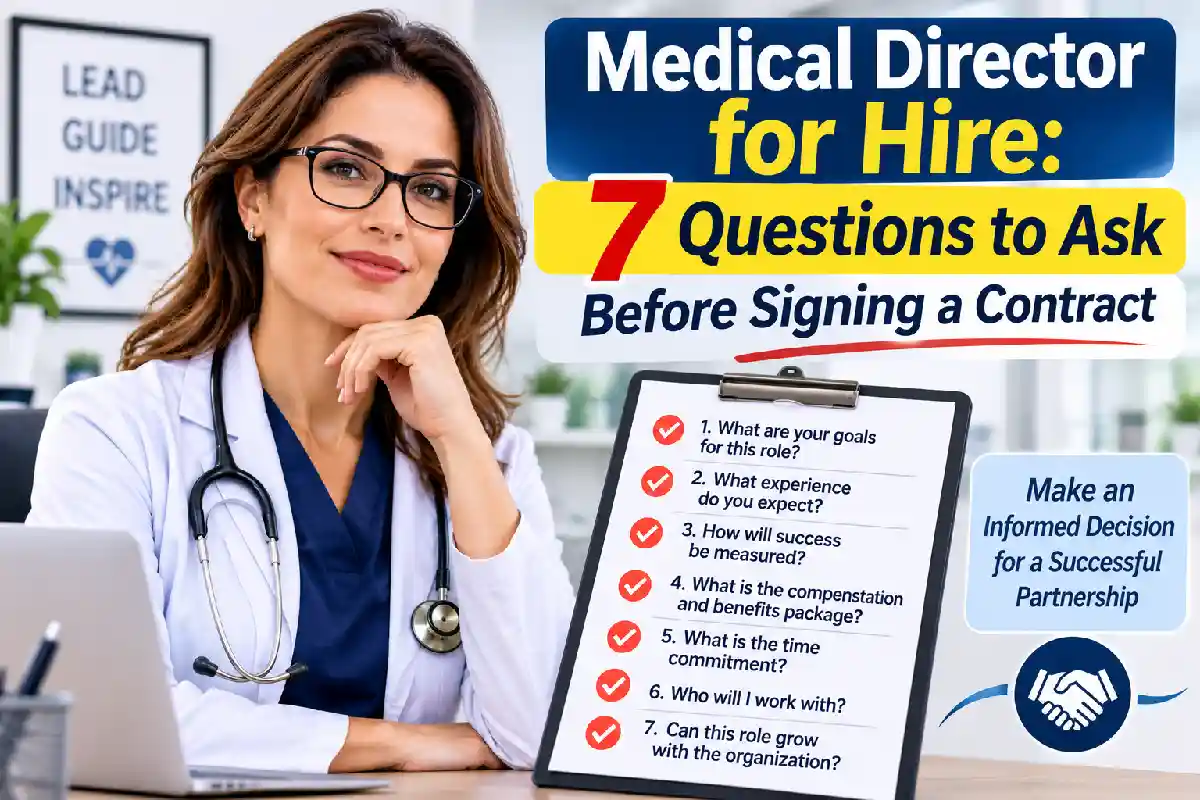
A medical director for hire can help a healthcare practice establish meaningful clinical oversight, but the contract matters just as much as the physician’s credentials. Before signing, owners should know who makes medical decisions, how supervision will work, and what happens when a patient needs urgent guidance. A monthly fee or impressive résumé does not answer those operational questions. The right agreement connects patient safety with clear responsibilities, reasonable access, and state-specific requirements. Whether you operate a med spa, IV therapy business, or another outpatient service, these seven questions will help you evaluate a proposed partnership before expectations turn into expensive misunderstandings.
Table of Contents
Key Takeaways
- Confirm the physician’s active license, relevant experience, and eligibility to oversee the services your practice actually offers.
- Define delegated activities, chart reviews, consultations, and documentation rather than relying on a vague promise of supervision.
- Protect independent clinical judgment and clarify which decisions belong to the physician versus practice management.
- Examine compensation, insurance, incident response, and responsibility for costs beyond the advertised monthly fee.
- Agree on termination notice, patient continuity, records, and replacement oversight before the relationship begins.
1. Is the Physician Qualified to Oversee Your Specific Services?
A medical director for hire should have an active license where the relevant care is delivered and experience that fits your treatment menu. A physician who has worked in an unrelated specialty may still bring valuable clinical skills, but you should not assume that every credential translates into the practical oversight your business needs. Ask about comparable clinical settings, the procedures involved, and any prior responsibility for supervising other licensed professionals.
Begin with primary-source license verification through the appropriate state medical board. Discuss disciplinary history or restrictions if they appear in an official record, and ask the physician to explain how they keep current with the treatments they would oversee. If your business operates in multiple states, assess the requirements and physician authority separately for each location instead of treating one agreement as a nationwide solution.
A strong interview also explores judgment. How does the physician decide when a procedure should not be offered? What patient factors trigger a referral or additional evaluation? The answers reveal whether the prospective director understands the clinical risks behind your service list. Document the accepted locations, specialties, and service lines in the agreement, and revisit the scope when you add new treatments. The goal is not to collect credentials for marketing. It is to match real qualifications with real clinical responsibility.
What Should You Verify Beyond a Medical License?
Physician credentials are a starting point, not a complete picture of medical director readiness. An active license confirms a core professional qualification, but it does not tell you whether a candidate has time to review charts, respond to clinical concerns, or help staff recognize complications. Ask for examples of how the physician has handled oversight in settings similar to yours, without requesting confidential patient information.
Discuss training relevant to the actual treatments, familiarity with current clinical protocols, and willingness to review your existing workflows before they approve anything. If the practice uses advanced devices, injectable medications, or clinician-performed procedures, ask how the physician evaluates staff competency and when they would require additional training. Their approach should reflect clinical risk rather than a one-size-fits-all checklist.
Finally, explore fit with your practice culture. Will the physician challenge a procedure they consider unsafe, even when it is commercially popular? Can they explain a clinical decision to managers without allowing business priorities to override patient welfare? Request references where appropriate and confirm how much time the role would realistically require. A careful screening conversation is valuable because the contract will only function well if the named physician is willing and able to carry out the duties it describes.
2. What Exactly Will the Medical Director Be Responsible For?
Medical director responsibilities should be specific enough that both sides can identify what successful performance looks like. A contract that promises only “oversight” leaves important tasks open to interpretation. Instead, identify who develops and approves clinical protocols, reviews charts, evaluates adverse events, addresses staff questions, and checks whether delegated activities are appropriate for each clinician’s license and training.
The agreement should distinguish clinical direction from day-to-day administrative work. Scheduling, payroll, advertising, and general operations may remain with the business, while treatment decisions and medical standards require authority consistent with professional and state requirements. Do not assume the physician’s signature allows staff to perform procedures that their own license or training would otherwise prohibit. Supervision and delegation rules differ by jurisdiction and profession.
Turn expectations into a usable workflow. Specify the services covered, the types of records reviewed, the review cadence, how findings are documented, and who follows up on recommended changes. Describe how new procedures or new clinical hires are evaluated before they begin treating patients. If your model involves standing orders or telehealth, define which clinician may authorize, update, and apply those processes. Clear duties prevent the medical director from becoming a title on a website instead of an active partner in the quality of care.
3. How Available Will the Physician Be When Your Team Needs Help?
Medical director availability should match your operating hours, patient volume, and the clinical risks of your services. A promise that the physician is “available as needed” sounds reassuring, but it does not explain what happens during a difficult consultation, an unexpected reaction, or a weekend appointment. Ask which issues warrant immediate contact, how the team should reach the physician, and what happens when the physician cannot respond.
Agree on practical communication channels and appropriate response expectations. Some matters can wait for scheduled chart reviews; others call for a prompt clinical decision or emergency escalation. Your written process should identify the person responsible for contacting the physician and explain when the team must follow emergency procedures instead of waiting for a message. The agreement should also account for vacations, illness, and other planned absences.
Access is only one part of the answer. Determine how clinical questions, recommendations, and follow-up actions will be recorded in a system that protects patient privacy. Regular meetings can help spot repeat problems, refine protocols, and identify where staff need support. Ask how much time the director expects to devote to training or quality improvement beyond individual consultations. If the proposed schedule cannot support your real workflow, negotiate the arrangement before signing rather than hoping it will improve later.
How Should Supervision and Chart Reviews Work in Practice?
Clinical supervision should have a documented method, not merely a line in the agreement. Before signing, ask how often the medical director will review patient records, what types of encounters will receive extra attention, and how concerns will reach the treating clinician. State rules and professional standards may impose particular requirements, so the final approach needs to reflect the practice location and services.
A useful review process may examine informed consent, treatment eligibility, follow-up plans, complications, medication documentation, and adherence to approved protocols. It should also explain what happens when a chart is incomplete or a clinician repeatedly makes the same mistake. A finding is not fully addressed just because it appears in a report. Someone must be assigned to implement the correction and confirm that it worked.
Ask where review notes will be stored, who can access them, and whether there is a process for urgent concerns between scheduled reviews. Staff should understand when to escalate a question and when to halt a procedure pending clinical guidance. If the physician offers only a limited amount of time each month, make sure the workload fits within it. The best plan is one your team can follow consistently and the physician can genuinely maintain.
4. Who Has Final Authority Over Clinical Decisions?
A medical director contract must protect professional clinical judgment while clarifying the limits of business management. Owners often control budgets, hiring logistics, branding, and customer experience, but clinical decisions cannot simply be treated as another marketing or revenue function. Depending on the state and entity structure, rules may also restrict who can own a medical practice or control particular professional decisions.
Ask who can approve or suspend a treatment protocol, decide whether a patient is an appropriate candidate, respond to a safety concern, and stop a service when staff lack required training. The physician’s responsibilities should be meaningful, and individual licensed clinicians still remain responsible for practicing within their own scope. The contract should not imply that a medical director can automatically override licensing laws or grant a blanket permission to provide medical care.
This is also the time to discuss conflicts. Suppose a popular service draws strong sales but creates repeated complications. Will the director have an effective way to require changes? How will the practice document disagreement between clinical and business leadership? Clear escalation and decision-making clauses protect patients and reduce friction when difficult choices arise. Have a healthcare attorney review the arrangement under the laws of your state, especially if ownership, delegation, or management-services arrangements are involved.
5. What Does the Fee Actually Include?
Medical director for hire pricing should be evaluated against documented work, not a monthly number in isolation. Two agreements with similar retainers may cover very different levels of access, training, chart review, protocol development, and support for additional locations. Ask for a written description of included services, expected hours, billing intervals, and any separate charges for unplanned consultations or expansion.
Review the payment structure for compliance as well as affordability. Physician compensation arrangements may implicate state fee-splitting restrictions, corporate practice rules, or other healthcare laws depending on the business model. Avoid assuming that a percentage of patient revenue or a referral-related incentive is appropriate. A qualified healthcare attorney can evaluate whether the compensation approach and any related business relationships are permissible.
Ask practical questions before committing: Are protocol updates included? Does an additional clinician or treatment require an added fee? What happens if patient volume doubles? Can the agreement be revised when the business changes? Record the process for approving new expenses so surprises do not accumulate. The cheapest proposal is not necessarily the best value if the physician cannot perform the duties your practice needs. A fair comparison considers the actual oversight deliverables, the reliability of communication, and how the relationship can grow without compromising care.
6. How Will Insurance, Liability, and Patient Incidents Be Handled?
Medical director liability should never be reduced to the assumption that one insurance policy protects everyone. Professional liability coverage for the physician, coverage for individual clinicians, and the practice’s business insurance may address different activities and exclusions. Ask each party’s insurer what is covered, particularly supervision, delegated services, specific procedures, and work performed across locations or through telehealth.
The agreement should explain responsibility for maintaining coverage, supplying proof, notifying the other party of material changes, and addressing any required extended reporting or tail coverage when the relationship ends. Review indemnification provisions with counsel rather than accepting broad language that shifts every loss to one party without context. Insurance obligations and legal responsibility are related, but they are not identical.
Also ask what happens immediately after an adverse patient event. Who communicates with the treating clinician, the medical director, the patient, and the insurer? Who documents the facts and coordinates any required reporting? Staff need a clinical response plan that prioritizes urgent patient care, with a separate process for preserving records and reviewing contributing factors. A contract cannot prevent every complication, but it can prevent confusion about who acts next. Make these duties clear before a high-pressure situation tests the partnership.
What Happens When an Unexpected Patient Safety Issue Arises?
Patient safety incidents call for an established response pathway rather than an improvised search for a supervisor. Before treatments begin, clarify which events require emergency care, which require immediate physician contact, and who takes responsibility for communicating follow-up instructions. The practice should maintain clinical protocols appropriate to the treatments offered and the competence of its staff.
The medical director’s participation may include reviewing the event, advising on clinical follow-up within the applicable scope of the role, and recommending corrective action. However, frontline clinicians must still act within their own professional duties, and emergency care should not be delayed while waiting for a director’s reply. Staff should know who can stop a procedure, how to access emergency equipment where appropriate, and how to protect patient information during communications.
After the immediate concern is addressed, the business and medical director should examine whether training, screening, consent, documentation, or a protocol needs improvement. Set a consistent method for recording those findings and checking that changes have been implemented. An agreement that discusses liability without discussing response and learning is incomplete. A patient-centered escalation plan helps your team act decisively and demonstrates why genuine medical oversight is more valuable than nominal affiliation.
7. What Happens if the Agreement Ends or Your Business Changes?
Medical director contract termination should have a practical plan for the period before, during, and after the relationship ends. Confirm the initial term, renewal process, notice requirements, grounds for immediate termination, and any obligations that survive the contract. A practice may need time to identify qualified replacement oversight, update protocols, and determine whether certain services must pause during a transition.
Ask what happens to chart access, patient records, clinical policies, standing orders, and pending quality reviews. Records must be managed according to applicable laws and professional responsibilities, not simply transferred or deleted for convenience. If the outgoing physician has been involved in ongoing care decisions, the transition should identify how those duties will be handled without compromising patient continuity.
Consider growth too. A new location, different state, expanded procedure menu, or additional clinical staff may change the appropriate oversight arrangement. Establish how revisions are proposed, approved, and documented. Avoid assuming that a contract written for today’s services automatically covers everything you hope to offer next year. Clear exit and change-management terms reduce disruption and help both parties end or reshape the relationship professionally. The best contract is not one that prevents every change. It is one that gives you a responsible way to manage change when it happens.
Conclusion: Sign for Real Oversight, Not Just a Title
Hiring a medical director involves more than comparing physicians and monthly fees. Before signing, verify relevant credentials, define real oversight duties, test the communication plan, preserve clinical decision-making authority, understand compensation, confirm insurance responsibilities, and agree on a safe transition process. Those seven questions turn a broad promise of support into a workable professional relationship. Because licensing, delegation, ownership, and contract rules vary by state and service, have qualified healthcare counsel review the final arrangement before care begins. A clear agreement is a stronger foundation for patient safety, staff confidence, and sustainable practice growth.
Find the Right Clinical Partner
Looking for a medical director who fits your healthcare practice? Explore Medical Director Co. to discuss your services, oversight needs, and the right next steps toward a well-defined working relationship.